

 Retirement Lifestyle Advocates


Weekly Update from RLA Tax and Wealth Advisory
By: Dennis Tubbergen
Stock Valuation Update
Last week, in this update, I provided evidence that the recent rise in stock prices is likely unsustainable over the long-term.
In just one year, the NASDAQ market has risen more than 60%!
 This week, I want to give you a couple more bits of evidence that support that theory. Again, as I stated in last week’s letter, I am not suggesting that a stock market correction is imminent; only that current valuations and recent price behavior should make any investor who is concerned with protecting profits be cautious.
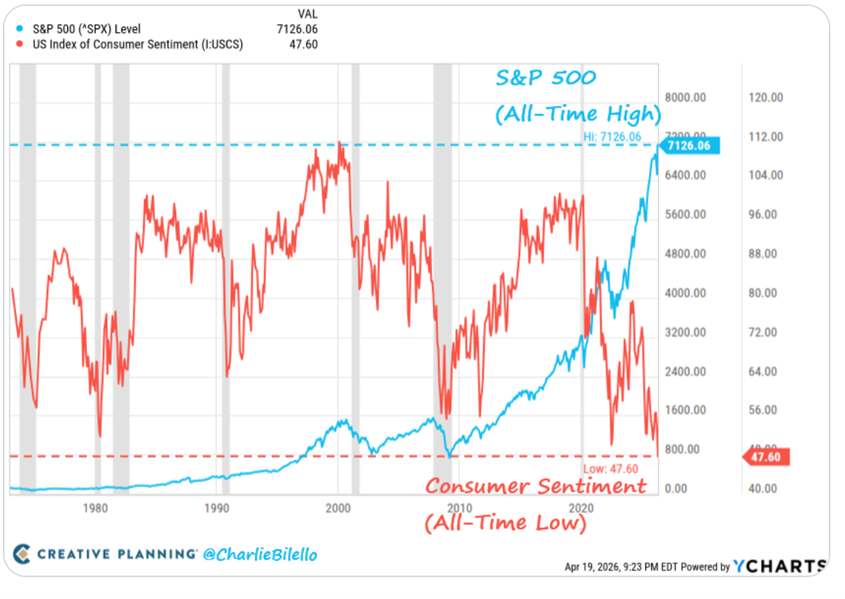
Stock prices and consumer sentiment are not in synch. Stocks, depending on the index you’re referencing, are either at or near all-time highs. The Dow Jones Industrial Average is just below its record high, while the Standard and Poor’s 500 is at its all-time high. At the same time, consumer sentiment is at record lows.
To use an old analogy, Wall Street is optimistic, and Main Street is pessimistic. The chart above illustrates. (Source: https://x.com/charliebilello/status/2046037937817563147/photo/1)
Notice from the chart (above) that, historically speaking, consumer sentiment and stocks have been somewhat correlated. When consumer sentiment is high, stocks have also tended to be high. That’s not the case presently. This could be a bearish sign for stocks.
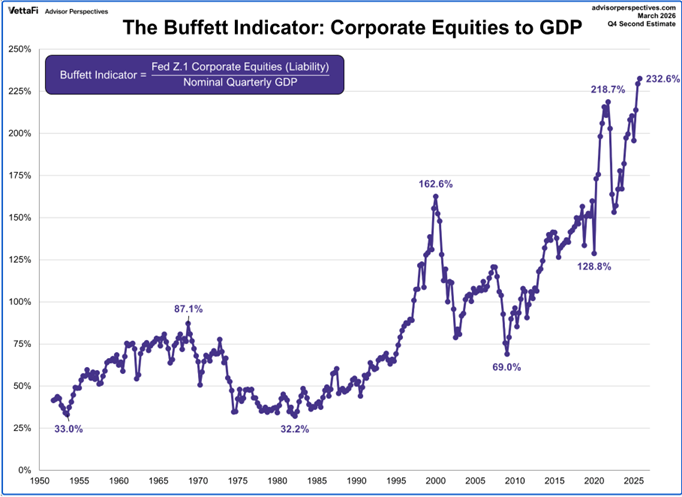 The Buffet Indicator, named after Warren Buffett, now the former CEO of Berkshire Hathaway, measures the total value of the stock market, or market capitalization, against economic output, or gross domestic product. The chart shows that the Buffett Indicator has never had stocks so overvalued as they are presently.
(ChartSource: https://www.advisorperspectives.com/dshort/updates/2026/04/07/buffett-valuation-indicator-march-2026)
Is This Another Sign That Stocks May Rollover?
Many readers are undoubtedly familiar with the fact that at the time of the tech stock bubble peaking about 25 years ago, there were many unprofitable companies that had wildly successful initial public offerings. An IPO is the first offering of a company’s stock.
In calendar year 2000, at the height of the dot-com stock hysteria, 81% of the companies going public were unprofitable. (Source: https://www.nysscpa.org/news/publications/the-trusted-professional/article/more-than-80-percent-of-ipos-come-from-companies-losing-money-100218#:~:text=This%20level%20of%20interest%20is,far%2C%20it%20is%2083%20percent.). Not long after that, stocks rolled over.
Could history now be repeating itself?
Reuters reported (Source: https://www.reuters.com/business/biggest-ipo-wave-history-promises-3-trillion-value-with-no-profits-2026-04-23/) that we are about to see the largest wave of initial public offerings in history, one that could see investors invest more than $3 trillion in three companies that have yet to make a profit. SpaceX, OpenAI, and Anthropic are all going public, and all three companies are losing money.
There are estimates that the three companies could have an initial combined market value of $3 trillion. That would be added to the current US stock market cap of $69 trillion.
SpaceX is planning an Initial Public Offering as early as June. The company had revenues of $18.6 billion last year and posted losses of about $5 billion. Yet, the company is targeting an IPO with an initial valuation of $1.75 trillion. If that valuation is achieved, it would be the largest initial public offering ever.
While there is an argument to be made for investing in unprofitable companies now to reap profits later, it’s difficult to make a lucid argument that a company with $5 billion in current losses has a value of $1.75 trillion.
Without debating the likelihood of ultimate success for these companies, the broader, more salient point is that unprofitable companies doing IPO’s often happen at market tops.
RLA Radio
The RLA radio program this week features an interview that I did as a guest on the Financial Survival Network with host Kerry Lutz.
I gave Kerry my view that stagflation is here. I also gave him my forecasts for markets moving ahead.
The interview is now posted and available by clicking on the "Podcast" tab at the top of this page, or you can find it on your favorite podcast channel.
Quote
“Genius may have its limitations, but stupidity is not thus handicapped.”
-Elbert Hubbard

Comments