

 Retirement Lifestyle Advocates


Weekly Update from RLA Tax and Wealth Advisory
By: Dennis Tubbergen
US Dollar Status as Reserve Currency Hits 31-Year Low
In the fourth quarter of 2025, US Dollar denominated reserves fell to 56.8% of total reserves. That’s the lowest level since 1994. (Source: https://wolfstreet.com/2026/03/28/status-of-us-dollar-as-global-reserve-currency-usd-share-drops-to-31-year-low-as-central-banks-diversify-into-other-currencies-gold/)
That statistic comes from the International Monetary Fund’s report on the currency composition of official foreign exchange reserves that we released last week.
These US Dollar-denominated reserve assets include U.S. Treasury securities, US mortgage-backed securities, US agency securities, US corporate bonds, and other assets, all denominated in U.S. dollars.
As Wolf Richter points out in the article link above, foreign central banks have not been dumping US-Dollar-denominated assets but rather have been buying assets in currencies other than the US Dollar.
This means that in real terms, US Dollar assets held by foreign central banks haven’t moved much, but reserve assets in other currencies have increased.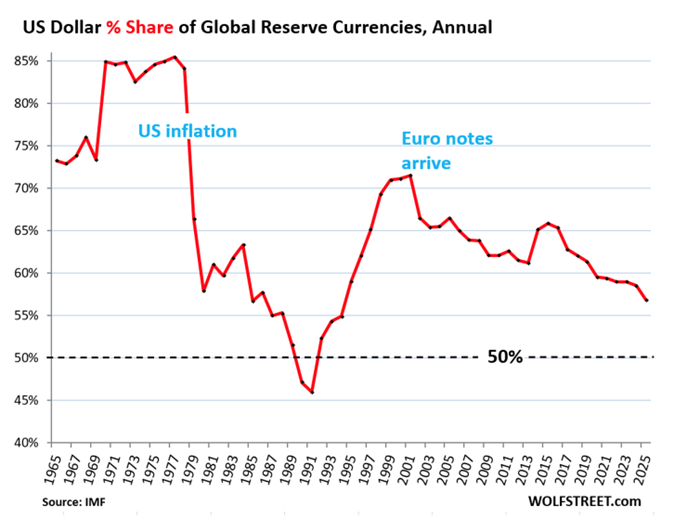
This chart from the article illustrates.
Notice that the current level of US dollar-denominated reserve assets is still higher than in the early 1990’s.
From the peak US Dollar reserve asset levels in the early 1970’s (the US Dollar was redeemable for gold at a rate of $35 per ounce through August 15, 1971) through 1991, foreign central banks lost faith in the US Dollar as the US economy was highly inflationary and endured four recessions.
Note from the chart that the US Dollar has been losing the confidence of foreign central banks since the turn of the century, twenty-five years ago.
These Funds Lacked Liquidity to Pay Investors
BlackRock’s HPS Corporate Lending Fund recently denied redemption requests from shareholders. The fund, with $26 billion in assets, issued a statement that shareholders requested 9.3% of their shares. BlackRock’s management determined that not all these redemption requests could be honored, capping the redemptions at 5%. In dollar terms, investors requested $1.2 billion, but only $620 million was redeemed. (Source: https://finance.yahoo.com/news/blackrock-26-billion-private-credit-195527199.html)
Blackstone’s private credit fund, BCRED, recently faced record-high redemption requests from fund investors. To meet all withdrawal requests, Blackstone company executives ponied up $400 million of their own capital. (Source: https://simplywall.st/stocks/us/diversified-financials/nyse-bx/blackstone/news/blackstone-faces-record-bcred-redemptions-as-investor-cautio)
Blue Owl Capital, a large player in the private credit space, stopped honoring redemption requests altogether and began issuing IOU’s to investors instead. (Source: https://standard.socratesplatform.com/Blog/Articles?class=Blog)
Morgan Stanley also capped redemptions from its North Haven Private Income Fund. The company stated it met 45.8% of redemption requests from shareholders after capping redemptions at 5% for the quarter. (Source: https://www.investing.com/news/stock-market-news/morgan-stanley-caps-redemptions-at-private-credit-fund-as-withdrawals-spike-4555938)
Not to be an alarmist, but I can’t help but see the parallels to 2007. In August of 2007, two hedge funds run by Bear Stearns folded after suffering mammoth-sized losses on subprime mortgage securities. Soon after, other funds followed suit.
Stocks largely held up until 2008 when the global financial crisis hit hard; then stocks collapsed.
While I wouldn’t go so far as to say that another global financial crisis is imminent, I would suggest moving forward in your investment portfolio with caution.
Silver Market to Benefit from Chinese Demand?
Long-term readers know that I am bullish on both silver and gold longer-term. What we are witnessing now in the gold and silver market, in my view, is normal consolidation after a counter-trend correction in a market that got extremely overbought. In other words, this market got a bit ahead of itself.
The fundamentals, though, favor more upside in the silver market. One of those fundamental factors that may drive silver prices higher is Chinese demand.
China imported 790 tons of silver through the first two months of 2026. 470 tons of silver flowed into China in the month of February alone. (Source: https://www.moneymetals.com/news/2026/03/23/china-is-gobbling-up-physical-silver-004782)
This increased Chinese demand is adding stress to silver supplies in a market that was already stressed. According to the Silver Institute, silver demand outstripped supply by about 95 million ounces in 2025. 2025 was the fifth straight year that there was a deficit in the silver market between demand and mining output.
Worldwide, silver inventories continue to fall. At some point in the near future, I believe this will lead to the next leg up in silver prices.
RLA Radio
The RLA radio program this week features an interview that I conducted with Ed Dowd, founder of Phinance Technologies. I talk to Ed about his forecasts for world markets and ask him about what he is presently advising his clients. The interview is now posted. Click on the "Podcast" tab at the top of this page to listen.
Quote
“I find television very educating. Every time somebody turns on the set, I go to the other room and read a book.”
-Groucho Marx

Comments