

 Retirement Lifestyle Advocates

 Weekly Update from RLA Tax and Wealth Advisory
By: Dennis Tubbergen
Dow to Gold Ratio Update
 For many years, I have been forecasting that we would ultimately, eventually see the Dow to Gold ratio fall to at least two, probably lower.
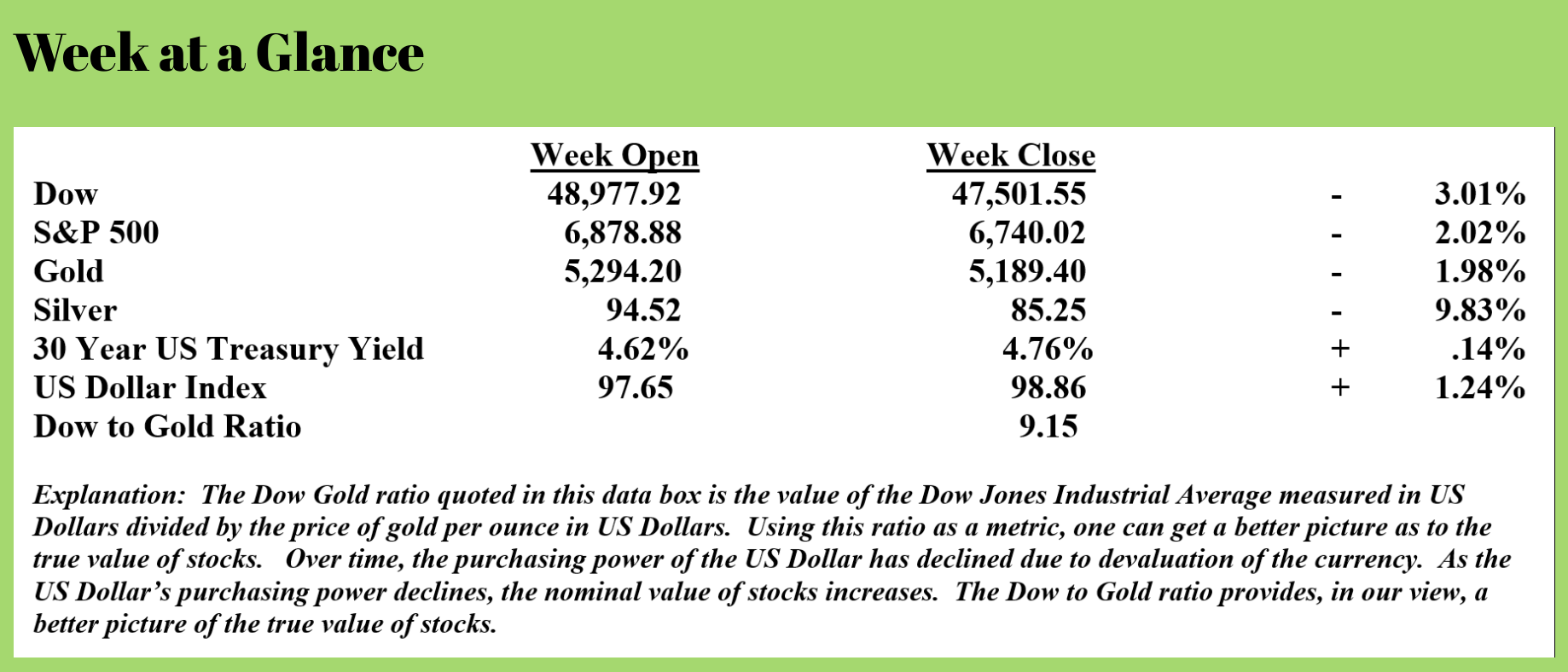
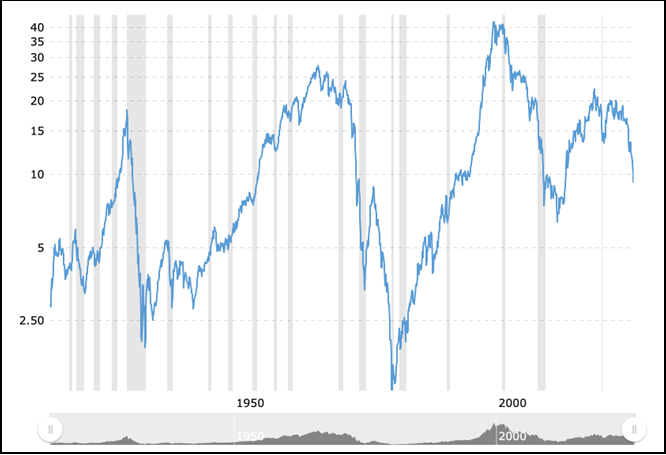
The Dow to Gold ratio is calculated by taking the value of the Dow Jones Industrial Average and dividing it by the price of gold per ounce. Presently, the Dow to Gold ratio stands at just over nine, down from a high of more than 40 twenty-five years ago. The chart illustrates.
When examining this ratio going back to the early 1900’s, one notes three highs, one in 1929, one in 1966, and one in 1999. There are two lows, one in 1932 and one in 1980. In 1932, the Dow to Gold ratio hit two, and in 1980 it hit one. In my view, we are now on our way to another low, and a ratio level of two or less is likely; one or less would not be surprising.
To reach that level, stocks will likely have to move down and gold will have to move higher. Technically, this ratio level could be seen with only a large move up in gold or only a large move down in stocks, but that is less likely.
Keep in mind that this cycle is long-term; it’s been 45 years since the last low.
More Americans Tapping 401(k) Plans
More Americans are digging into their 401(k) plans for financial emergencies.
According to Vanguard, 6% of the workers who have 401(k) plans with the company took hardship withdrawals. That’s up from 4.8% in 2024. (Source: https://www.wsj.com/personal-finance/retirement/record-numbers-of-workers-are-raiding-their-401-k-savings-bc89d5c3?mod=hp_lead_pos4&mod=djemalertNEWS)
Hardship withdrawals from 401(k) plans have been increasing since 2018. The top reasons for 401(k) plan withdrawals were to avoid foreclosure or eviction or to pay medical bills.
This excerpt is from the article in “The Wall Street Journal”:
“More Americans are falling behind on debt payments, including on some types of mortgages, putting them at risk of foreclosure. The average income of clients seeking help from credit-counseling agencies is rising. Still, unemployment remains low, and consumer spending has been healthy.”
That excerpt seems to be contradictory on the surface, but it’s a perfect explanation of the bifurcation that is now occurring in the US economy. In short, the wealthy are getting wealthier, and the poor and middle class are increasingly struggling.
There are political snake oil salespeople like Bernie Sanders attempting to make political hay from this fact by demonizing the wealthy. Senator Sanders, along with Representative Ro Khanna, just proposed the “Make Billionaires Pay Their Fair Share Act” (Source: https://www.sanders.senate.gov/press-releases/news-sanders-and-khanna-introduce-legislation-to-tax-billionaire-wealth-and-invest-in-working-families/). The act would establish a 5% wealth tax on billionaires annually.
While this proposal will undoubtedly resonate with many in the electorate, particularly those who are struggling to make ends meet, it will never work.
One, it assumes that billionaires have 5% of their wealth liquid and available to pay taxes. As you undoubtedly know, wealth is not created nor accumulated in liquid cash accounts. If a billionaire has an appreciated asset, will they be forced to liquidate the asset and pay capital gains taxes, and then pay the wealth tax with whatever funds are left?
Two, how will the actual wealth of billionaires be calculated, and who will make the determination? Closely held businesses, many real estate holdings, and some collections are simply difficult to value. Will this legislation create a “Department of Valuations” run by bureaucrats who’ve never built a business or wealth?
Three, while a wealth tax may begin with billionaires, it won’t end there. Just look at the government’s track record. When the income tax became permanent in 1913, only ‘wealthy’ people were to pay the tax. Adjusted for inflation using the price of gold per ounce as a metric, the current equivalent of the level at which income taxes began was about $1,000,000 annually. Income taxes were originally levied on only those earning more than $4,000 per year, and the income tax rate was 1%. In 1913, gold was $20 per ounce. Today, with gold at more than $5,000 per ounce, the current equivalent would be approximately $1,000,000 per year. That’s how new taxes have always been introduced – only tax the wealthy. Then, over time, that tax affects much or most of the population.
There is a parallel example with the Social Security tax. The original tax was set at 1% total for the employer and employee. Today, with Medicare taxes included, the total tax rate is 15.3%.
Four, the wealthy will vote with their feet. A billionaire tax will ensure that billionaires will move to a more welcoming country. Just look at the recent exodus of billionaires from California to Nevada and Florida; capital goes where it is respected.
Always has, always will.
The solution to the wealth gap problem is not rhetoric in the form of legislation. The solution to the wealth gap problem is a system of sound money.
The wealth gap exists because the wealthy and affluent have assets that nominally appreciate with inflation. Those living paycheck-to-paycheck don’t have assets, and their incomes are not keeping up with living expenses. Their pain is real, as noted by the increasing levels of hardship withdrawals from 401(k) plans. This solution is not a solution; it’s just more political pandering.
That said, some of these tax for those with assets "solutions" will likely get some traction in the coming years. The national debt and the level of unfunded liabilities that the US has are simply unpayable. That’s not an opinion; that is a fact verified by the math. The Social Security system will be totally broke in less than six years. That’s another indisputable fact. New taxes are likely coming at some point. If you have assets, the time to do tax planning is now, while there is still time and there are strategies available to use.
RLA Radio
The RLA radio program this week features an interview that I conducted with Michael Pento, the host of the Midweek Reality Check podcast. Michael and I chat about his forecasts for the US economy and various financial markets. Listen now by clicking on the "Podcast" tab at the top of this page.
Special Note
I was saddened to learn of the passing of Coach Lou Holtz this past week. I had an opportunity to spend some time with Coach Holtz 15-20 years ago (as evidenced by the old photo of us here when I still had some hair!) when he spoke at an event that I hosted.
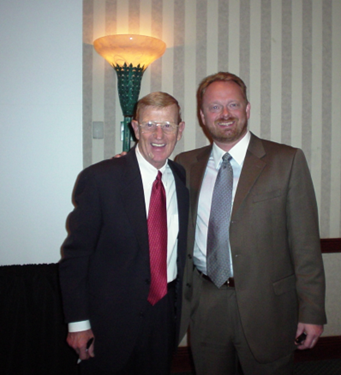 Coach Holtz was one of the most genuine and nicest people that I have ever met. And, what a great motivator.
He was born of very humble beginnings but embraced solid principles from which he never strayed. I remember him sharing these principles: always do the right thing, always do the best you can and always show people you care.
A truly great man who touched many people.
“No one ever drowned in sweat.”
“Never tell anyone your problems. 90% of the people don’t care, and the other 10% will be glad you have them.”
-Both quotes from Coach Holtz

Comments